Mussel
Zebra Mussel
Dreissena polymorpha
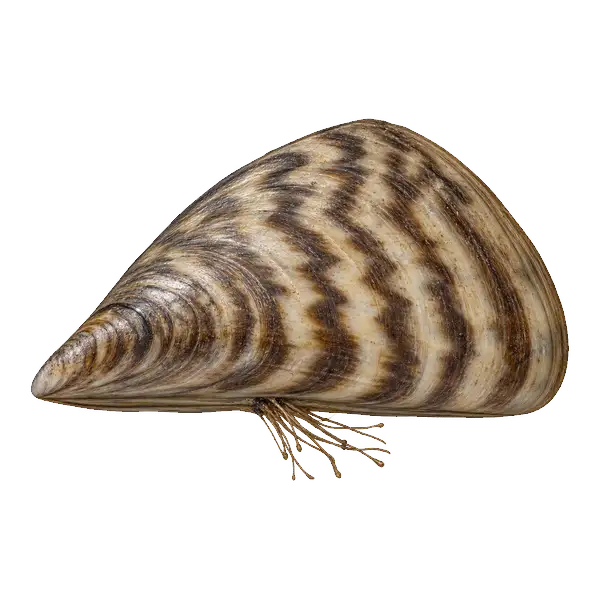
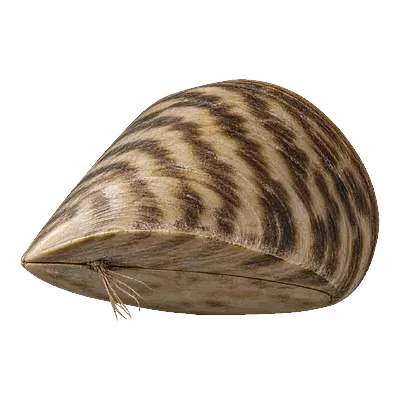
These illustrations are AI-generated, not photographs, and are not to scale. They show what to look for; they are not a substitute for an expert identification.
How to identify it
Size: About 1 inch long, often smaller.
- A D-shaped or triangular shell with a sharp ridge along one edge.
- A flat underside, so the shell sits upright if you set it down.
- Dark and light zigzag or wavy stripes. The pattern varies and can be faint.
- Fine threads that glue it to rocks, docks, boats and other shells, often in clusters.
Don’t confuse it with
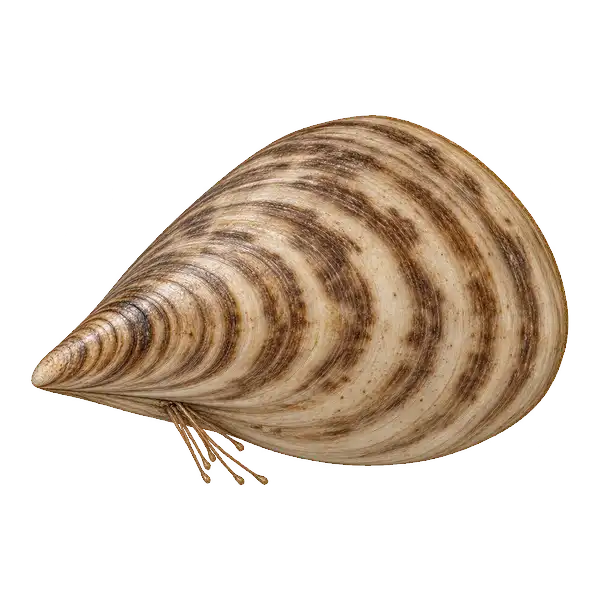
Quagga mussel, another invasive, is rounder and has no flat underside: set one on its side and it rolls over. Native mussels are much larger, have no attachment threads, and live partly buried in the lake bottom.
Where it came from
Native to the Black Sea and Caspian Sea region of eastern Europe and western Asia.
Carried to the Great Lakes in the ballast water of ocean-going ships in the 1980s. It reaches inland lakes mostly on boats, trailers and gear, and as tiny free-floating young in bilge and live-well water.
Earliest dated Ohio record: 1988, Lake Erie at Fairport Harbor, Lake County. This is the oldest dated record in the USGS non-native species database, not necessarily when it first arrived.
Why it matters
Zebra mussels filter large amounts of water, removing the plankton that young fish and many native animals feed on. They coat docks, boat hulls, water intakes and native mussels, and their sharp shells cut bare feet on beaches.
Ohio law
Designated an injurious aquatic invasive species in Ohio. Under Ohio Administrative Code 1501:31-19-01 it is illegal to possess, import, release into the wild or sell it alive, and a dead one may be kept only if it is headless, preserved or gutted. Named in OAC 1501:31-1-02(LLL)(3). Ohio DNR’s aquatic invasive species page.
If you find it
- Don’t move it. Before leaving the water, clean off all plants, animals and mud, drain water from your boat, live well, bilge and bait bucket, and let everything dry before you launch somewhere else. Ohio DNR asks every boater and angler to do this.
- Never release bait or pets. In Ohio it is illegal to release any fish or aquatic invertebrate into a water it did not come from without Division of Wildlife permission. Put unused bait in the trash. Bait and invasive species
- Report it. Take a photo, note exactly where you saw it, and send it to the Ohio Division of Wildlife with its aquatic invasive species reporting form, or call 1-800-WILDLIFE (1-800-945-3543). Experts there can confirm what you found.
- Ask before treating. Before using herbicides or other treatments in a lake, ask the lake’s owner and the Ohio DNR what permission is needed.
Ohio lakes where it has been recorded
28 Ohio lakes on this site have a record of this species.
Ashland
Belmont
Crawford
Delaware
Harrison
Mahoning
Noble
Pickaway
Scioto
Summit
Trumbull
Warren
A lake that is not listed may still have it. Records exist only where someone found the species and reported it, so “not recorded” does not mean “not present.”
Lake records: the U.S. Geological Survey Nonindigenous Aquatic Species database, matched to each lake by the record’s own coordinates. A record means the species was found there at least once, not that it is there now.
Sources
- USGS Nonindigenous Aquatic Species: Zebra mussel fact sheet
- Ohio Administrative Code 1501:31-19-01: injurious aquatic invasive species
- Ohio Administrative Code 1501:31-1-02, paragraph (LLL): the list of species
- Ohio DNR: Injurious aquatic invasive species
Earliest dated record: USGS Nonindigenous Aquatic Species database.