Shoreline and shallow-water plant
Flowering Rush
Butomus umbellatus
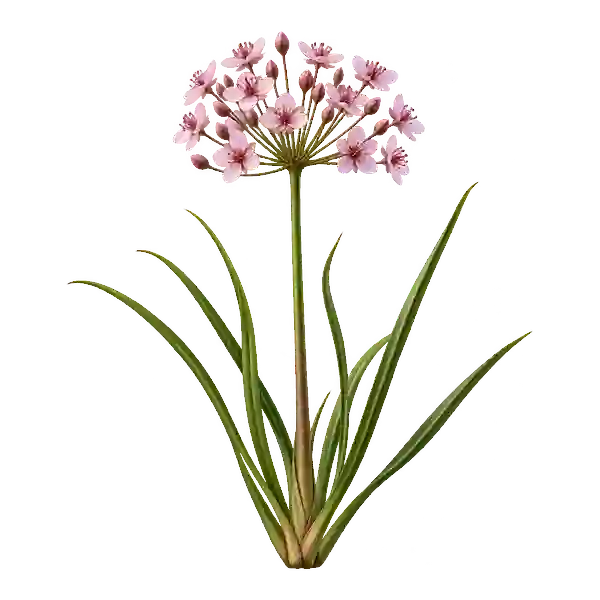
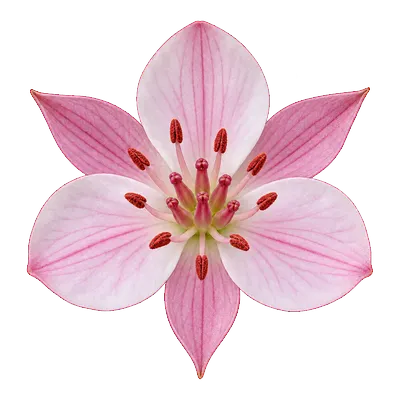
These illustrations are AI-generated, not photographs, and are not to scale. They show what to look for; they are not a substitute for an expert identification.
How to identify it
Size: Grows along shores and in shallow water. It can also grow completely underwater, where it does not flower.
- Long, narrow leaves that are triangular when you cut across them, often twisting near the tip.
- In summer, a rounded, umbrella-shaped cluster of pink-to-white flowers on a tall stalk.
- Each flower has three broad petals and three smaller sepals, with darker veins and red centers.
Don’t confuse it with
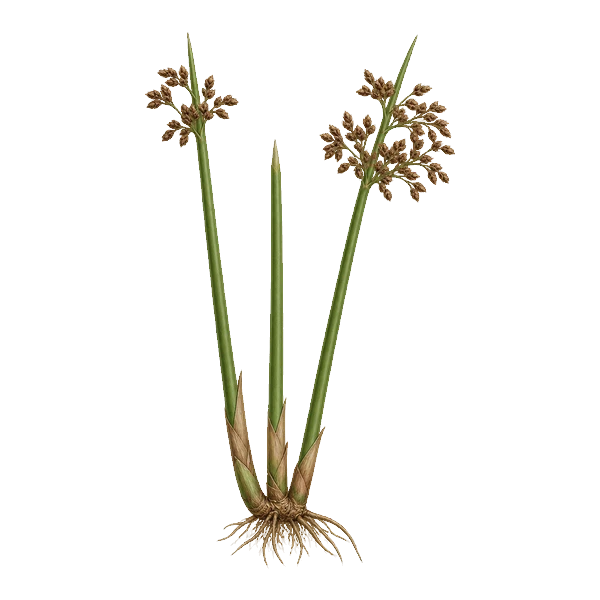
Without flowers it can pass for native bulrushes or bur-reeds. Flowering rush's leaves are triangular where you cut across them and often twist near the tip. Bulrushes are mostly bare stems with their leaves reduced to sheaths at the base, and some native bulrushes have three-sided stems of their own, so shape alone does not settle it. If you are not sure, report it.
Where it came from
Native to Europe and Asia.
Brought to North America as a garden plant and first recorded along the St. Lawrence River in the late 1800s. It spreads by root pieces and small bulb-like buds that break off and float away.
Earliest dated Ohio record: 1933, Little Cedar Point, Lucas County. This is the oldest dated record in the USGS non-native species database, not necessarily when it first arrived.
Why it matters
It forms dense stands along shores and in shallow water that crowd out native plants and can get in the way of swimming and boating.
Ohio law
Listed as an invasive plant by the Ohio Department of Agriculture (Ohio Administrative Code 901:5-30-01). No one may sell, offer for sale, propagate, distribute, import or intentionally spread it in Ohio. Removing and disposing of it is allowed. Listed in OAC 901:5-30-01(A)(6). Ohio DNR’s aquatic invasive species page.
If you find it
- Don’t move it. Before leaving the water, clean off all plants, animals and mud, drain water from your boat, live well, bilge and bait bucket, and let everything dry before you launch somewhere else. Ohio DNR asks every boater and angler to do this.
- Never release bait or pets. In Ohio it is illegal to release any fish or aquatic invertebrate into a water it did not come from without Division of Wildlife permission. Put unused bait in the trash. Bait and invasive species
- Report it. Take a photo, note exactly where you saw it, and send it to the Ohio Division of Wildlife with its aquatic invasive species reporting form, or call 1-800-WILDLIFE (1-800-945-3543). Experts there can confirm what you found.
- Ask before treating. Before using herbicides or other treatments in a lake, ask the lake’s owner and the Ohio DNR what permission is needed.
Ohio lakes where it has been recorded
3 Ohio lakes on this site have a record of this species.
A lake that is not listed may still have it. Records exist only where someone found the species and reported it, so “not recorded” does not mean “not present.”
Lake records: the U.S. Geological Survey Nonindigenous Aquatic Species database, matched to each lake by the record’s own coordinates. A record means the species was found there at least once, not that it is there now.
Sources
- University of Nevada Extension: Flowering rush
- Ohio Administrative Code 901:5-30-01: invasive plant species
Earliest dated record: USGS Nonindigenous Aquatic Species database.