Underwater plant
Eurasian Watermilfoil
Myriophyllum spicatum
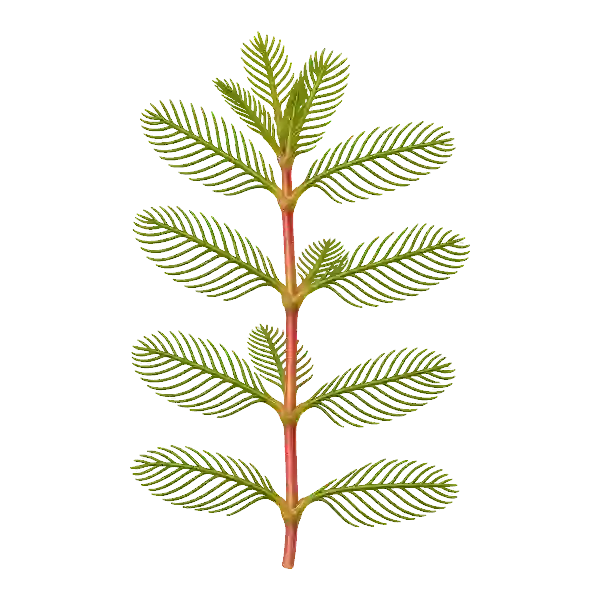
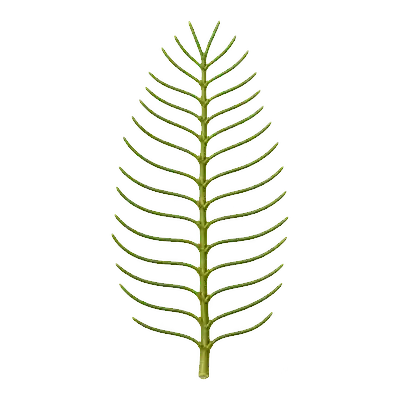
These illustrations are AI-generated, not photographs, and are not to scale. They show what to look for; they are not a substitute for an expert identification.
How to identify it
Size: Leaves about 1/2 to 2 inches long, on long stems that can reach the surface.
- Soft, feathery leaves in rings (whorls), usually four to a ring, around the stem.
- 12 or more pairs of thread-like leaflets on each leaf. Count them: this is the most useful check.
- Leaf tips that often look blunt, as if clipped off.
- Reddish stem tips, often branching near the surface.
Don’t confuse it with
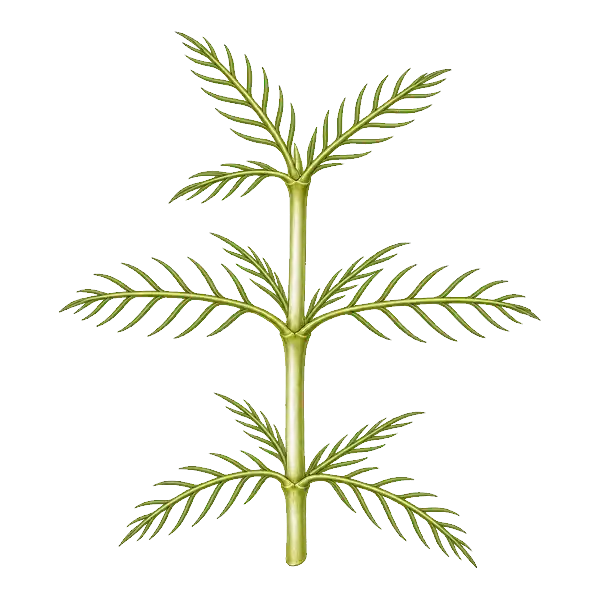
Native northern watermilfoil usually has fewer leaflet pairs, about 5 to 10, and stiffer leaves. The two can also cross, and the hybrid can be hard to tell apart without a lab test.
Where it came from
Native to Europe, Asia and northern Africa.
Established in North America by the mid-1900s. It spreads between lakes mainly as plant pieces caught on boats, trailers, motors and fishing gear. A single piece can start a new plant.
Earliest dated Ohio record: 1948, Middle Harbor, Ottawa County (Lake Erie). This is the oldest dated record in the USGS non-native species database, not necessarily when it first arrived.
Why it matters
It can form thick mats at the surface that crowd out native plants, make swimming and boating difficult, and change the habitat fish use.
Ohio law
Listed as an invasive plant by the Ohio Department of Agriculture (Ohio Administrative Code 901:5-30-01). No one may sell, offer for sale, propagate, distribute, import or intentionally spread it in Ohio. Removing and disposing of it is allowed. Listed in OAC 901:5-30-01(A)(39). Ohio DNR’s aquatic invasive species page.
If you find it
- Don’t move it. Before leaving the water, clean off all plants, animals and mud, drain water from your boat, live well, bilge and bait bucket, and let everything dry before you launch somewhere else. Ohio DNR asks every boater and angler to do this.
- Never release bait or pets. In Ohio it is illegal to release any fish or aquatic invertebrate into a water it did not come from without Division of Wildlife permission. Put unused bait in the trash. Bait and invasive species
- Report it. Take a photo, note exactly where you saw it, and send it to the Ohio Division of Wildlife with its aquatic invasive species reporting form, or call 1-800-WILDLIFE (1-800-945-3543). Experts there can confirm what you found.
- Ask before treating. Before using herbicides or other treatments in a lake, ask the lake’s owner and the Ohio DNR what permission is needed.
Ohio lakes where it has been recorded
34 Ohio lakes on this site have a record of this species.
Allen
Ashtabula
Athens
Belmont
Carroll
Fairfield
Fulton
Guernsey
Harrison
Hocking
Huron
Jackson
Logan
Medina
Monroe
Morgan
Morrow
Pickaway
Richland
Trumbull
Williams
A lake that is not listed may still have it. Records exist only where someone found the species and reported it, so “not recorded” does not mean “not present.”
Lake records: the U.S. Geological Survey Nonindigenous Aquatic Species database, matched to each lake by the record’s own coordinates. A record means the species was found there at least once, not that it is there now.
Sources
- USGS Nonindigenous Aquatic Species: Eurasian watermilfoil fact sheet
- Ohio Administrative Code 901:5-30-01: invasive plant species
Earliest dated record: USGS Nonindigenous Aquatic Species database.