Underwater plant
Curly-leaf Pondweed
Potamogeton crispus
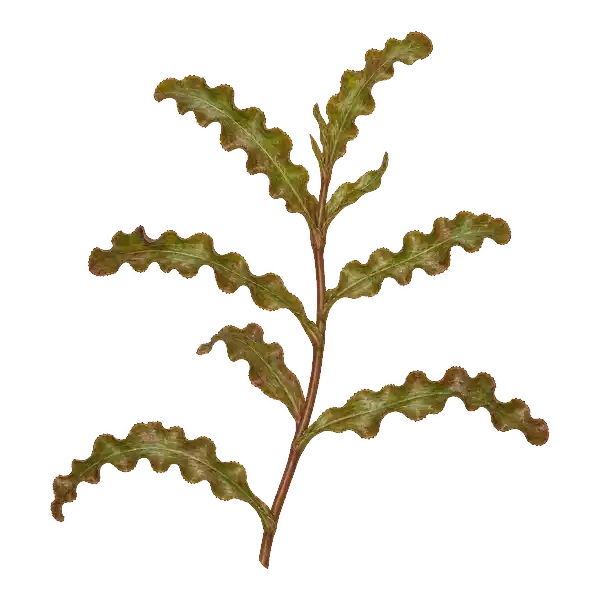
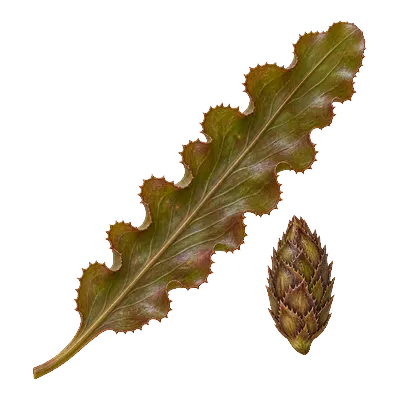
These illustrations are AI-generated, not photographs, and are not to scale. They show what to look for; they are not a substitute for an expert identification.
How to identify it
Size: Leaves about 2 to 4 inches long.
- Leaves with wavy, crinkled edges, like the edge of a lasagna noodle.
- Tiny teeth along the leaf edges. Look closely or run a fingertip along one.
- Olive-green to reddish-brown color.
- Leaves spaced one at a time along the stem, alternating sides.
- In late spring it forms hard, bur-like buds called turions that sink and sprout later.
Don’t confuse it with
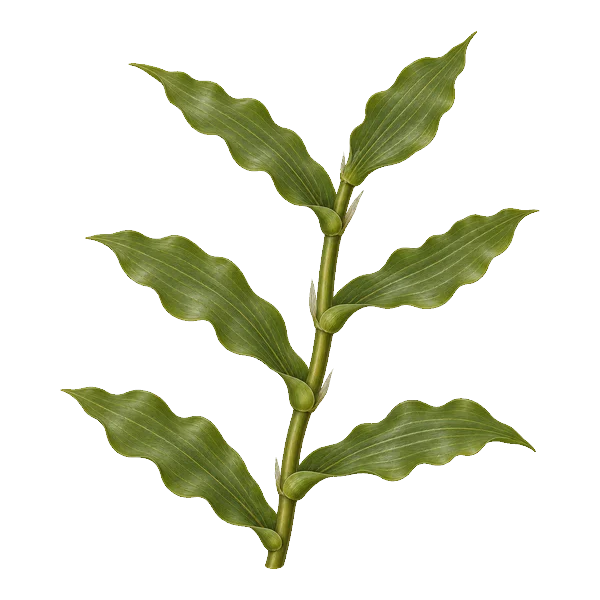
Native clasping-leaf pondweed has wavy leaf edges too, so waviness does not tell them apart. Its edges have no teeth — run a fingertip along one — and its leaf bases wrap right around the stem.
Where it came from
Native to Europe, Asia, Africa and Australia.
Present in North America since at least the mid-1800s. It spreads by stem pieces and turions carried on boats and gear.
Earliest dated Ohio record: 1910, Cedar Point, Erie County. This is the oldest dated record in the USGS non-native species database, not necessarily when it first arrived.
Why it matters
It starts growing very early, even under ice, and can form thick mats in spring before native plants get going. It dies back in early summer, and the rotting plants can release nutrients that feed algae blooms.
Ohio law
Listed as an invasive plant by the Ohio Department of Agriculture (Ohio Administrative Code 901:5-30-01). No one may sell, offer for sale, propagate, distribute, import or intentionally spread it in Ohio. Removing and disposing of it is allowed. Listed in OAC 901:5-30-01(A)(48) as curly pondweed. Ohio DNR’s aquatic invasive species page.
If you find it
- Don’t move it. Before leaving the water, clean off all plants, animals and mud, drain water from your boat, live well, bilge and bait bucket, and let everything dry before you launch somewhere else. Ohio DNR asks every boater and angler to do this.
- Never release bait or pets. In Ohio it is illegal to release any fish or aquatic invertebrate into a water it did not come from without Division of Wildlife permission. Put unused bait in the trash. Bait and invasive species
- Report it. Take a photo, note exactly where you saw it, and send it to the Ohio Division of Wildlife with its aquatic invasive species reporting form, or call 1-800-WILDLIFE (1-800-945-3543). Experts there can confirm what you found.
- Ask before treating. Before using herbicides or other treatments in a lake, ask the lake’s owner and the Ohio DNR what permission is needed.
Ohio lakes where it has been recorded
28 Ohio lakes on this site have a record of this species.
Allen
Ashtabula
Athens
Belmont
Champaign
Crawford
Delaware
Geauga
Highland
Jackson
Jefferson
Logan
Medina
Monroe
Morgan
Morrow
Trumbull
Warren
A lake that is not listed may still have it. Records exist only where someone found the species and reported it, so “not recorded” does not mean “not present.”
Lake records: the U.S. Geological Survey Nonindigenous Aquatic Species database, matched to each lake by the record’s own coordinates. A record means the species was found there at least once, not that it is there now.
Sources
- Midwest Invasive Species Information Network: Curly-leaf pondweed
- Ohio Administrative Code 901:5-30-01: invasive plant species
Earliest dated record: USGS Nonindigenous Aquatic Species database.