Snail
Chinese Mysterysnail
Cipangopaludina chinensis
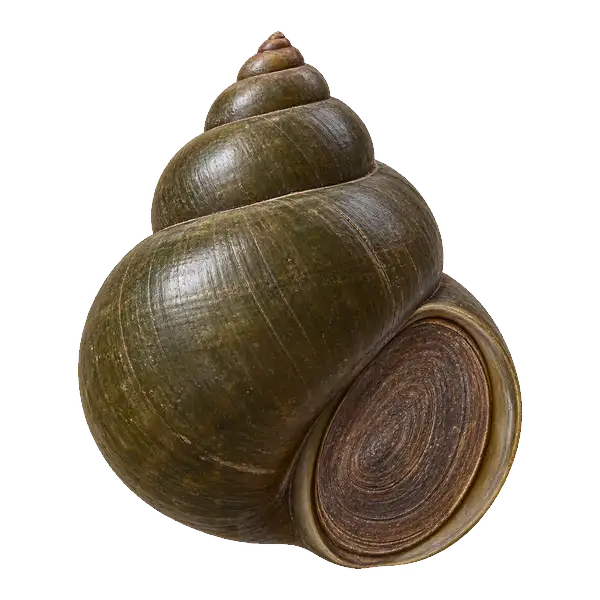
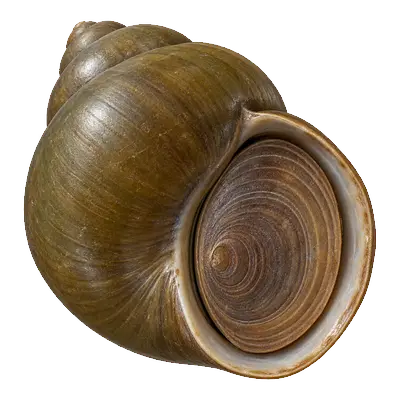
These illustrations are AI-generated, not photographs, and are not to scale. They show what to look for; they are not a substitute for an expert identification.
How to identify it
Size: Shell up to about 2.5 inches tall, about the size of a golf ball.
- A large, round, globe-shaped shell.
- A smooth olive-green to brown shell with no bands.
- A hard lid with rings like a tree stump that closes the opening.
- Often noticed when empty shells wash up on a beach.
Don’t confuse it with
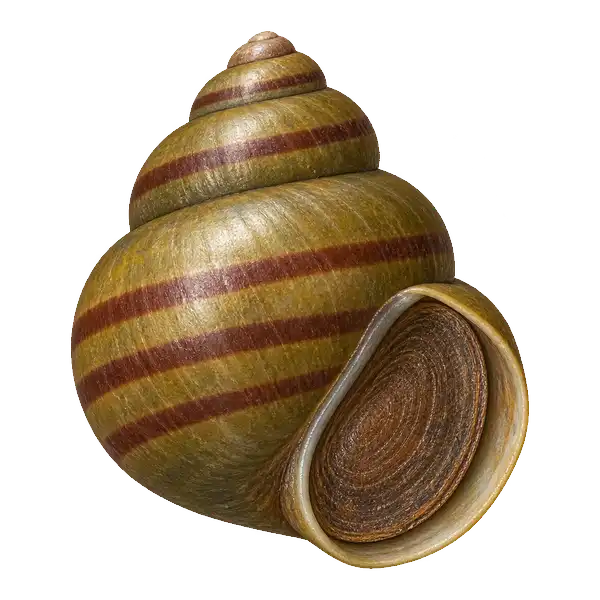
The banded mysterysnail is smaller and has reddish-brown bands. Most native lake snails in Ohio are much smaller.
Where it came from
Native to eastern Asia.
Brought to North America in the late 1800s for food markets, and later sold for aquariums and water gardens. Releases from those sources are thought to explain many populations.
Earliest dated Ohio record: 1944, Maumee River drainage, Wood County. This is the oldest dated record in the USGS non-native species database, not necessarily when it first arrived.
Why it matters
It can reach very high numbers, compete with native snails and carry parasites. Large die-offs leave piles of shells along the shore.
Ohio law
Not on Ohio's injurious aquatic invasive species list or its invasive plant list. Ohio law still forbids releasing any fish or aquatic invertebrate into a water it did not come from without Division of Wildlife permission. Ohio DNR’s aquatic invasive species page.
If you find it
- Don’t move it. Before leaving the water, clean off all plants, animals and mud, drain water from your boat, live well, bilge and bait bucket, and let everything dry before you launch somewhere else. Ohio DNR asks every boater and angler to do this.
- Never release bait or pets. In Ohio it is illegal to release any fish or aquatic invertebrate into a water it did not come from without Division of Wildlife permission. Put unused bait in the trash. Bait and invasive species
- Report it. Take a photo, note exactly where you saw it, and send it to the Ohio Division of Wildlife with its aquatic invasive species reporting form, or call 1-800-WILDLIFE (1-800-945-3543). Experts there can confirm what you found.
- Ask before treating. Before using herbicides or other treatments in a lake, ask the lake’s owner and the Ohio DNR what permission is needed.
Ohio lakes where it has been recorded
22 Ohio lakes on this site have a record of this species.
Ashtabula
Carroll
Clermont
Columbiana
Crawford
Geauga
Guernsey
Highland
Hocking
Jefferson
Logan
Morrow
Muskingum
Portage
Richland
Scioto
Shelby
Summit
Trumbull
Wayne
A lake that is not listed may still have it. Records exist only where someone found the species and reported it, so “not recorded” does not mean “not present.”
Lake records: the U.S. Geological Survey Nonindigenous Aquatic Species database, matched to each lake by the record’s own coordinates. A record means the species was found there at least once, not that it is there now.
Sources
- USGS Nonindigenous Aquatic Species: Chinese mysterysnail fact sheet
- Midwest Invasive Species Information Network: Chinese mystery snail
- Ohio Administrative Code 1501:31-13-01 (release of fish and aquatic invertebrates)
Earliest dated record: USGS Nonindigenous Aquatic Species database.